Archives for August 2008

FE-36 Clean Agent

With the worldwide ban on Halon 1211, the race was on to create a clean, safe alternative for use in highly sensitive areas. As a result, the US manufacturing giant DuPont created FE-36, or Hydrofluorocarbon-236fa (HFC-236fa).

FE-36 works almost as effectively as the illegal halon, is less toxic, and does not deplete the ozone layer. FE-36 also leaves no residue, is non-corrosive, non-conductive, and will not cause thermal shock damage to machinery.

How Fire Extinguishers Containing DuPont FE-36 Work

These extinguishers discharge a stream of gas and liquid droplets that are propelled into the heart of the fire, stopping combustion through a chemical reaction and by absorbing the fire’s heat.

Since FE-36 becomes a gas at -1.4 degrees C (39 degrees F), it leaves no residue behind and after the fire, dissipates into the atmosphere. FE-36(tm) fire extinguishers can be used on fire classes A and B, and directly on electrical equipment.

FE-36 Fire Extinguishers in Europe

Although not yet widely available in the UK and Europe, these extinguishers are used in medical facilities across the USA. In addition, portable fire extinguishers containing FE-36 can be used in sensitive locations such as computer rooms, document stores, clean rooms, telecommunications facilities, control rooms, switch rooms, marine craft and installations, banks, museums, archives, laboratories, and airplanes.

The most common range of fire extinguishers containing FE-36 are Cleanguard extinguishers from Ansul.

In the UK Today

Motorsport participants might also be interested in the Zero 360, an FE-36 extinguisher especially for high performance racing and rally cars from Lifeline.

Also seen in small automatic extinguishers, the defunct Firemaster company’s previous management have set up a new company called Fireblitz Extinguisher and are now supplying 1kg and 2kg automatic sizes again.

“Total Flood” Fire Suppressant Systems

DuPont FE-36 can now be used to replace Halon 1301 in fixed fire protection systems. Fire extinguisher systems with FE-36 come into their own where a ‘total flood’ fire suppressant system is required. This involves ‘flooding’ an entire room or enclosed area with sufficient fire fighting agent to extinguish the fire. (If CO2 gas were used instead, the volumes involved would prove fatal to anyone in the area.)

FE-36 and Hydrogen Fluoride

When combusted, under certain conditions, FE-36 can produce hydrogen fluoride (HF). Whilst this gas is generally produced in small quantities, and the gas itself boils just below room temperature, you should make sure that after a fire, the area is fully ventilated before staff return.

You should also avoid breathing in any fumes from an FE-36 extinguisher treated fire, as on contact with moisture, including human tissue, hydrogen fluoride converts to hydrofluoric acid. This acid is highly toxic and corrosive.

MRI-Safe Fire Extinguishers

MRI-safe fire extinguishers are designed to protect these expensive and life-saving machines from damage in the event of a fire. High specification CO2 fire extinguishers and water mist extinguishers are designed with non-magnetic components to be able to operate in the vicinity of a magnetic resonance imaging (MRI) machine.

How MRI-Safe Fire Extinguishers Work

MRI-safe fire extinguishers are essentially the same as normal extinguishers on the inside. However, MRI-safe fire extinguisher cylinders must be non-magnetic, as the magnetic field of an MRI machine is strong enough to attract a normal fire extinguisher with bone-crushing force.

It is not often realised but the magnetic potency of an MRI machine stays for a long time after it is turned off. This prevents fire-fighters from entering with something as simple as a metal belt buckle. There have been incidents of people being “sucked” into an MRI with tragic results.

The same rule applies to any machinery with a strong magnetic field, such as nuclear magnetic resonance spectrometers (NMR’s). Non-magnetic fire extinguishers should also be used in health centres, clinics, and any premises where magnetic interference might affect the performance or operation of sensitive equipment.

Non-magnetic fire extinguishers are made with a non-magnetic stainless steel or aluminium shell, and non-magnetic fittings such as valves, nozzles and pins.

Specially manufacturerd 2kg CO2 fire extinguishers are the most popular non-magnetic type in the UK, since they can be used to extinguish fires in, on or around electrical equipment, are clean to operate and do not leave any residue after use. The non magnetic fire extinguisher is available online from Fire Protection Online and is made by Chubb Fire (and also sold under their sister company name of Thomas Glover).

Water Mist Fire Extinguishers

Amerex Corporation of the USA developed their water mist extinguisher for use in clean rooms, telecoms areas and health care facilities. Using distilled water instead of tap water, it has a specially-developed misting nozzle that atomizes the water making it non-conductive.

These are available in 1.75 gallon and 2.5 gallon size and as a 9 litre size in the UK (model 272) BAFE approved to BS EN3. They have UL approval in the USA.

As you can imagine, high specification non-magnetic fire extinguishers do not come cheap, retailing at a premium to the standard models. But, they can be found online at much lower prices.

UK Fire Safety Regulations

New fire safety regulations were recently passed that affect all workplaces in England and Wales. While many workplaces have the basic precautions in place, there are many that don’t. Once you know the basics, such as how to assess the risk and what fundamental safety measures are required, fire safety is not a difficult topic, and the new fire safety regulations will be easy to implement.

The Regulatory Reform (Fire Safety) Order 2005, as it is known (or RRO), is designed to turn almost all the earlier pieces of UK fire safety legislation into one all-inclusive law.

Here is a short précis of the important parts of the Order that concern all those who run a business or institution situated in a building, based on key words used and their meanings:

  • Responsible Person: the person who owns or controls the business or premises
  • Competent Person: this could be an employee or an outside contractor appointed and trained to carry out fire fighting duties, contact the emergency services, and assist in evacuations
  • Enforcement: failing to satisfy the applicable articles of the Order may result in a fine or up to two years imprisonment
  • Fire Risk Assessment: if the responsible person employs 5 or more people, or if the premises are licensed, or if the inspector wants it, this vital plank of the Order must be officially documented

Application

The Fire Safety Order applies to all buildings in use, except domestic premises and some kinds of premises that are a specific risk and where other regulations apply. It also places duties on a ‘responsible person’ not only to protect employees but members of the public.

Don’t forget that every building is going to be different – different fire hazards in different places affecting different people.

Fire Risk Assessment

The Law requires that Risk Assessment be done, consistent with most of the new regulations regarding health and safety. It is important to consider how a fire would affect the people in the building, starting with those immediately at risk from the fire.

The outcomes of the Risk Assessments must be presented in writing where five or more people are employed, in line with many other regulations.

Fire Prevention

One of the reasons for Fire Risk Assessment is to lessen the chances of fire occurring. A fire prevention plan should be easy to put together and should be a matter of common sense for most workplaces.

Some measures to consider include making sure rubbish is not stored near the premises, and ensuring that the electrical wiring is tested and inspected frequently.

Fire Precautions

There are a number of general fire precautions required by the regulations but it is important to remember that every workplace is different and every work location has different needs. What works in one building might not work elsewhere.

The most important fire safety regulations to consider include:

  • A whistle or an electric fire alarm, or some other kind of fire warning
  • Automatic fire detectors might be needed in some buildings, especially if a fire could be a risk to people if it is not detected (such as a two-story building) or there are large numbers of people in the building
  • There must be fire extinguishers in the building, not only to maintain exits while people evacuate but also to control small fires
  • There must be enough fire exits in the building for the numbers of people who use it and exits must lead as directly to safety as possible
  • Exits must be clearly marked with exit signs and they must be kept clear and readily available
  • Fire exit routes might need to be protected so that the smoke and flames won’t affect people evacuating the building
  • Emergency lighting might be needed in some situations to light exit routes and rooms in the event of a power failure
  • Fire equipment must be maintained and looked after, so that they are in working order
  • There must be a fire procedure for the building, outlining people’s responsibilities and the evacuation plan in case of fire

Summer Fire Home Safety

Fire home safety is something that should be thought about all year round. However, when it comes to summer time people can often get a little negligent with their safety. Longer nights, warmer days and a relaxed and fun atmosphere can all lead to various accidents occurring and one of those is the risk of a fire.

Why the Summer Months Pose a Bigger Threat

When summer comes you are likely to want to enjoy every moment of sun that you are given. This means that BBQ’s and picnics out there in garden are often enjoyed all throughout summer.

Now a BBQ can be fun; especially if you invite plenty of people! But there is also a risk that a fire could break out; especially if alcohol is involved. So you need to ensure that you follow the right summer fire home safety guidelines.

  • Some Fire home safety guidelines that you should follow include:
  • Ensure that the BBQ is away from fences and sheds
  • Keep all pets and children away from the BBQ
  • Once all of the food has been cooked, turn off the gas cylinder before the BBQ controls
  • Make sure any guests to the picnic/BBQ do not throw cigarettes on the lawn
  • Be sure to get rid of any glass and bottles in your garden

If you follow these guidelines then you will ensure that you and your guests are as safe as possible.

You may not think that your BBQ could be a potential fire risk, but if not done properly, accidents do happen. By leaving bottles and glass on the lawn for example, the sunlight can cause the lawn to set on fire through the glass.

Also if guests are drinking and they then throw a cigarette onto the garden, which can also start a fire as the lawn will be dry due to the hot summer weather. So it is always better to follow these safety rules in order to have the best possible time at your picnic/BBQ.

Children and Fire Safety

If you have children, or if you are having children around the home throughout summer, you will need to keep a close eye on them. Many times a fire can be started simply because a child has been left unsupervised.

Also, when you are having a BBQ, children can often get too close to the BBQ and it could easily be knocked over. So always keep your children away from the BBQ and never leave them unsupervised in the home either.

It is possible that whilst you are outside, a fire could be started in the home. Perhaps you have left something cooking and due to the heat and perhaps the distraction from friends and family, you have forgotten about it. This can start a fire and you may be blissfully unaware of it until it is too late.

So you really need to ensure that you keep an eye on everything that you are cooking. Also never leave children unattended in the home whilst all of the adults are outside as this is only asking for problems. You can purchase various fire safety home improvements such as smoke detectors which really do prove to be vital if there is ever a fire.

Overall by following simple fire home safety guidelines you can easily enjoy the summer months with friends and family.

Fire Safety Training

Yes, It Is a Legal Requirement! Under the Regulatory Reform (Fire Safety) Order 2005, as the owner or occupier of non-domestic premises, you are the ‘responsible person’ who must arrange staff training, fire drills and evacuation procedures and policies for your staff and visitors.

Why Invest in Quality Fire Safety Training?

As a business owner, you have probably already invested heavily in fire safety equipment for your premises. Yet all that investment will effectively go to waste if your staff does not know how to use fire safety equipment such as fire extinguishers, as they may well be the first person to discover a fire.

What Your Staff Need to Know about Fire Safety

The occasional fire drill and some faded escape notices are no longer acceptable to fulfill your legal obligations under the Fire Safety Order. Your staff needs to be aware of:

  • your business fire safety policy, and who to contact when in the case of an emergency
  • your fire safety and evacuation procedures; when and how to act if they discover a fire
  • the fire safety equipment used on your premises, and how to operate them if required
  • the fire safety signs, what they mean, and how to act accordingly
  • The Best Fire Safety Training Delivery Method

Fire safety training could help save both lives and property, but only if it is delivered properly and in such a way that staff engage and learn the important information effectively.

Fire safety manuals can be dull and hard to read, and many people find it tricky to understand how to use fire safety equipment from a drawing or series of diagrams. In addition, you or your competent person can never be 100% sure the information has been fully read and absorbed!

Offsite or Onsite fire safety training gives your staff the opportunity to focus solely on fire training, but it can be costly both in terms of the fees charged by external companies and the time taken to deliver training to all staff.

Online courses in fire safety training are a useful aid for staff that like to learn in their own time and at their own pace, but again you as the business owner, cannot be sure the information has been fully absorbed and understood.

Fire Safety Training DVDs and CD-ROMS

One of the best ways to ensure training is delivered in a consistent way across your entire business is to use DVD or CD-rom training courses. By dividing your staff into small groups, your personnel can learn together in a structured way, without the need to remove large numbers of staff from the workplace at one time, as with outside raining.

They can learn from top experts featured on the DVDs, and actually see how to operate fire extinguishers and other safety equipment, rather than learn from diagrams. And, of course, if anyone needs a recap, you simply play the DVD segment again!

Unlike paper manuals that can become out of date and forgotten on a shelf, a DVD training course can be renewed on a subscription basis each year, to give your staff the most up to date training information available. It is also useful for refreshing your staff fire training on a regular basis, by revising individual modules rather than the whole course.

Fire safety training is the essential element that will keep your business and staff safe when combined with the right fire safety equipment; one without the other is as good as useless.

Know Your Extinguishers

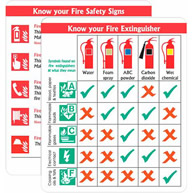
In the event of a fire, using the correct extinguisher to put it out is as important as discovering the fire itself. All modern fire extinguishers are clearly marked as to the type of fire they should be used on, so you can tackle small fires safely and easily.

Different Fires Require Different Fire Extinguishers

It sounds obvious, but different types (or classes) of fire require different extinguishers. For example, a water-based extinguisher is ideal for use on free-burning materials such as paper or wood, known as a Class 1 fire. For full details, see our in-depth guide to fire extinguisher types

UK Fire Extinguisher Markings and Colours

All fire extinguishers are colour coded for easy recognition in an emergency. They also have ratings as to which class of fire they can be effective in extinguishing, so you can double-check that you have the right fire extinguisher for the job.

In addition all fire extinguishers should bear quality standard marks, such as the familiar BS Kite Mark and CE Mark. For full details on classes of fires and extinguisher ratings, see the detailed guide to fire extinguisher fire ratings and multi-rating fire extinguishers

A Fire Extinguisher in the Hand

A fire extinguisher is only truly effective when you, the person picking it up in an emergency knows the best way to use it! Our handy guide to how to use a fire extinguisher takes you through simple steps for efficient fire extinguisher use.

Fire Extinguisher In-depth Guides

The best and clearest fire extinguisher information, right here at your fingertips.